
Living in a harmonious environment can profoundly influence how we feel, think, and move through our daily lives. The spaces we inhabit are never neutral. They carry energy, memory, and subtle emotional signals that can either support our well-being or create discomfort.
Many times, when entering a certain place, we feel an immediate and almost inexplicable desire to leave. In contrast, there are environments where we naturally feel at ease, inspired, or deeply comfortable. According to Feng Shui, these reactions are not random. They are connected to the energetic quality and balance of the space itself.
Understanding the Flow of Chi
Feng Shui is an ancient Taoist philosophy that studies the relationship between human beings and the environments that surround them. At its core lies the concept of Chi or Qi, a vital life force believed to sustain all living things. Similar ideas appear in other traditions. In Hindu philosophy, for instance, this universal energy is known as Prana.
In Feng Shui, Chi is said to move with the wind and be gathered by water. The harmonious circulation and containment of this energy within a space supports health, emotional balance, prosperity, and creativity. This principle is reflected in the very name Feng Shui, which translates as “Wind” and “Water.”
In many ways, Feng Shui acts on interiors much like acupuncture works on the human body. Both practices aim to release energetic blockages and encourage the natural flow of life force.
The Balance of Yin and Yang
Harmony in the universe arises through balance. The symbol of Yin and Yang represents two opposing yet complementary forces that exist in all aspects of life. Neither can exist without the other, and their interaction creates movement, transformation, and renewal.
“Everything carries both Yin and Yang within itself, and from their alternating rise and fall new life emerges.” — Lao-tzu
Traditionally, Yin is associated with qualities such as night, softness, stillness, coolness, and introspection. Yang represents brightness, warmth, activity, structure, and expansion. In interior spaces, achieving a balance between these two energies creates environments that feel both grounding and energizing.
Different Schools of Feng Shui
Over centuries, different schools of Feng Shui have developed, each offering unique methods for analyzing and harmonizing spaces. Among the most traditional are the Form School and the Compass School. Together, they form what is often referred to as Classical Feng Shui.
The Form School focuses on physical surroundings and spatial relationships. It uses symbolic celestial animals — such as the Green Dragon, White Tiger, Black Turtle, and Red Phoenix — to describe energetic support and positioning within a landscape or home.
The Compass School relies on directional measurements using the Lo Pan, a specialized Feng Shui compass. This approach may also consider factors such as construction periods, personal birth data, and temporal cycles to evaluate energetic influences.
A more modern interpretation known as the Black Hat School gained popularity in Western countries through the teachings of Thomas Lin Yun. This system simplifies certain calculations and often uses the main entrance as a reference point instead of cardinal directions.
The Ba-Gua Map and Life Aspirations
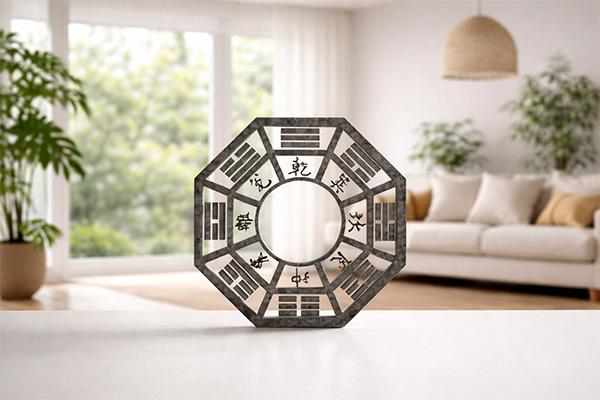
One of the most accessible tools in Feng Shui is the Ba-Gua map. Rooted in the ancient wisdom of the I Ching, this diagram represents eight key life aspirations arranged around a central space.
When applied to the floor plan of a home, the Ba-Gua helps identify energetic zones connected to areas such as career, reputation, prosperity, relationships, creativity, family, helpful people, and personal growth. Depending on the school being used, the map may be aligned with cardinal directions or positioned according to the front door.
The Five Elements and Energetic Cycles
Feng Shui also recognizes five essential elements — Water, Wood, Fire, Earth, and Metal. Each element is associated with particular colors, materials, shapes, and emotional qualities.
These elements interact in cycles that can be supportive, weakening, or controlling. Understanding these relationships allows subtle adjustments within interiors. Introducing living plants can stimulate vitality and growth. Warm lighting may activate the fire element, encouraging passion and visibility. Metal accents can support clarity and organization.

Feng Shui as a Daily Awareness
Beyond symbolic diagrams and technical calculations, Feng Shui can become a gentle way of observing how we live. It invites us to notice where energy feels stagnant, where light no longer reaches, or where objects accumulate without intention.
Simple changes — opening windows, rearranging furniture, introducing color, or removing what no longer serves us — can gradually transform the emotional atmosphere of a home. Over time, these mindful actions cultivate environments that feel lighter, more supportive, and more aligned with personal well-being.
A Living Relationship with Space
Feng Shui does not require perfection. It begins with awareness. By developing sensitivity toward the relationship between inner life and outer surroundings, we learn to design spaces that nurture us. A harmonious home becomes more than a physical setting. It becomes an active partner in creativity, balance, and emotional renewal.