
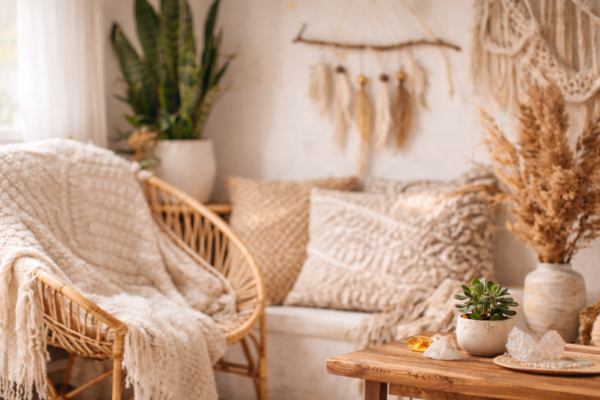
Boho is often mistaken for a decorating trend — a look, a Pinterest board, a collection of colors and textures arranged to resemble freedom. However, authentic Boho living reaches far beyond aesthetics. It is not something that can be copied from a catalog or recreated by following rules. Boho, in its truest form, is a mood.
It is a quiet atmosphere that slowly emerges when a home stops trying to impress and begins to simply exist. In fact, Boho spaces rarely feel forced. Instead, they evolve naturally as objects, memories, and textures accumulate over time. Because of this, a Boho home rarely looks “finished.” It continues to grow alongside the life being lived inside it.
When a space feels layered, imperfect, and deeply personal, you are already living in a Boho way — whether you consciously call it that or not.
A Home That Breathes
Boho homes rarely begin with a precise design plan. Instead, they evolve slowly, guided by instinct rather than strict aesthetic formulas. One object appears, then another, and gradually the space begins to develop its own quiet rhythm.
Natural materials, handmade objects, and soft layers allow the environment to feel alive rather than static. Meanwhile, light moves across the room throughout the day, transforming textures and colors as it travels.
At some point, something subtle shifts in the way you decorate.
You stop asking whether things match.
You begin asking whether they feel right.
At some point, you stop asking if things match and start asking if they feel right.
This change in perspective is what allows a home to breathe. Instead of following rules, the space becomes a reflection of the people who live inside it.
Collected, Not Styled
Unlike trend-driven interiors, Boho spaces grow through accumulation rather than careful staging. A woven basket may come from a weekend market. A small ceramic bowl might travel home from another country. Meanwhile, a handmade object could appear quietly during a slow afternoon of creativity.
Over time, these pieces begin to form a visual memory of the life unfolding inside the home.
Boho interiors allow everyday objects to carry emotional meaning:
- A worn rug that has moved from room to room over the years.
- A chair that technically does not belong — yet somehow feels perfect.
- Sunlight that enters the room at different hours and changes everything.
Consequently, decorating becomes less about styling and more about remembering.
The Beauty of Imperfection
One of the quiet foundations of Boho living is the acceptance of imperfection. In many ways, this idea reflects the philosophy of wabi-sabi — the appreciation of things that are natural, aged, or slightly irregular.
A hand-woven textile may not be perfectly symmetrical. A ceramic bowl might contain small variations in its glaze. However, these imperfections are precisely what make the object feel alive.
Perfectly manufactured decor can sometimes feel cold or distant. Handmade pieces, on the other hand, carry traces of human presence. They remind us that homes are not showrooms. They are places where real life unfolds.
Because of this, Boho spaces often feel warm and approachable rather than polished and rigid.
The Language of Color and Soul
Color also plays a very different role inside a Boho home. Rather than existing to impress visitors, color becomes a quiet form of expression.
Earthy tones help ground the environment and create warmth. Meanwhile, unexpected bursts of color introduce moments of joy and spontaneity. Natural light then activates these tones, allowing materials and textures to change subtly throughout the day.
Plants often play an important role in this atmosphere as well. Their presence introduces movement and softness into the room while also connecting the interior space with the natural world outside.
This is one of the reasons handmade decor feels so different in a Boho environment.
These objects do not simply decorate a space.
They carry time, intention, and human energy.
Nature as a Living Element
Boho homes rarely separate themselves from nature. Instead, they invite it inside.
Plants soften architectural lines. Natural fibers introduce texture. Sunlight becomes part of the decor itself as it moves slowly across walls and furniture. If you’re curious about which plants carry symbolic meaning, you may enjoy reading : Plants That Attract Good Luck
Even small elements can shift the atmosphere of a room. A plant placed near a window, for example, may create subtle shadows that change throughout the day. A woven basket or wooden table adds warmth that manufactured materials often lack.
Because of this, Boho spaces rarely feel static. They feel alive, continuously changing as light, seasons, and daily routines unfold.
Permission to Be Yourself
Ultimately, Boho living has very little to do with trends. Instead, it offers something far more valuable — permission. Permission to mix styles, follow instinct, and allow a home to evolve naturally over time.
A Boho home does not try to be perfect.
It simply tries to be honest.
And in the end, that is where its beauty lives.